
The G20 foreign ministers' meeting on Thursday was unable to come out with a joint communique due to sharp differences over the Ukraine conflict despite persistent efforts by host India to build consensus.
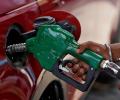
'Pump prices of petrol and diesel have reached historical highs. An unwinding of taxes on petroleum products by both the Centre and the states could ease the cost-push pressures,' the Monetary Policy Committee (MPC) has said.

The President in his address to the joint sitting of Parliament unveiled the policies and priorities of the Bharatiya Janata Party-led National Democratic Alliance government which assumed power last month after elections to the 16th Lok Sabha.

'The Centre and state need to take a unified approach and take concerted action before this matter assumes menacing proportions because unemployment, the drug trade and the levels of frustration among the youth make them vulnerable to any maverick who promises something better.'

The Union government could target a fiscal deficit of 5.8-6 per cent of nominal GDP for 2023-24, and it should continue its capital expenditure push and look to simplify the personal income tax regime, economists recommended Finance Minister Nirmala Sitharaman and her team during their pre-Budget interaction on Monday. Starting last week, Sitharaman had eight pre-Budget consultations this time. More than 110 invitees representing seven stakeholder groups participated in these meetings, the finance ministry said in a statement. The stakeholder groups included representatives and experts from agriculture and agro-processing industry; industry, infrastructure & climate change; financial sector and capital markets; services and trade; social sector; trade unions and labour organisations; and economists.

One hopes in his next term, Narendra Modi will take up the mission of inculcating respect for following rules in Indians as a mission. Therein lies the chance for India to become a developed country, asserts Colonel Anil A Athale (retd).

Another bill related to the farm sector, the Essential Commodities (Amendment) Bill, was passed on Tuesday.
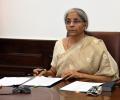
Rationalisation of income tax slabs, infrastructure status for digital services and incentives to hydrogen storage as well as fuel cell development were some of the suggestions made by various stakeholders at the pre-Budget consultation meeting convened by Finance Minister Nirmala Sitharaman. The customary pre-Budget consultation meetings were held with the finance minister virtually between December 15 and December 22, as per the finance ministry statement. More than 120 invitees representing seven stakeholder groups participated in eight meetings, scheduled during this period, it said.
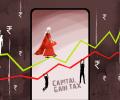
Equity benchmarks Sensex and Nifty ended on a mixed note on Wednesday as the euphoria about the Budget fizzled out, with investors going for profit-taking ahead of the Fed interest rate decision. The 30-share BSE benchmark Sensex climbed 158.18 points or 0.27 per cent to settle at 59,708.08 after it trimmed most of the intra-day gains. During the day, it had zoomed 1,223.54 points or 2 per cent to 60,773.44.

'The government should act proactively to instil confidence in the private investors, and also boost the purchasing power of people directly or indirectly by ensuring minimum wages.'

Billionaire Mukesh Ambani on Tuesday hinted at rolling out 5G telecom services in the second half of 2021 and said policy steps are needed to accelerate the early rollout of ultra-high-speed 5G services that are affordable and available everywhere. Ambani, whose four-year-old telecom venture Jio has captured the No.1 spot offering free voice calling and data at dirt-cheap rates, also pitched for developing hardware manufacturing in India, saying the nation cannot rely on imports in such a critical area. 5G is the 5th generation mobile network that enables connecting virtually everyone and everything together including machines, objects, and devices. India, he said, is today among the best digitally connected nations in the world.
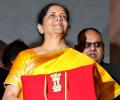
The immediate need is to put more money in the hands of agriculture-based and rural households to improve their purchasing power, says S Mahendra Dev.

Nirmala Sitharaman's messaging was clear when she presented a well-balanced Budget with an eye on state elections in nine states followed by a general election next year, observes Ramesh Menon.

In the interest of the people and welfare of the state, Pawar is always available for guidance and suggestions to whoever is in power, he said.

Finance Minister Nirmala Sitharaman on Wednesday raised the personal income tax rebate limit, doled out sops on small savings and announced one of the biggest hikes in capital spending in the past decade as she did a tight rope walk in the Budget between staying fiscally prudent and meeting public expectations in the year before general elections.
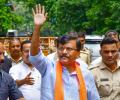
The arrest of Shiv Sena MP Sanjay Raut in a money laundering case by the Enforcement Directorate (ED) was "illegal" and a "witch-hunt", a special court in Mumbai said on Wednesday while granting him bail in the Patra Chawl redevelopment matter.
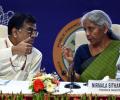
'...Market-linked debentures, high-value insurance, exemptions from capital gains by investment in real estate, etc.' 'So, there are a number of measures directed at collecting a fair share from higher income individuals.'

Prime Minister Narendra Modi and Home Minister Amit attended the swearing in ceremony as did BJP president J P Nadda.
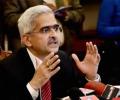
Stating that recent agriculture reforms have opened new opportunities, the RBI Governor said the farm sector is emerging as a bright spot.

'It is building the country's infrastructure, and delivering it very efficiently.'
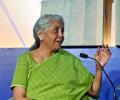
Finance Minister Nirmala Sitharaman on Thursday said inflation management cannot be "singularly" left to the monetary policy as a majority of activities are outside its purview in the current context. Speaking at a seminar organised by economic think-tank Icrier, the finance minister said that both the fiscal policy and the monetary policy have to work together to contain inflation. Consumer price index (CPI) based inflation or retail inflation is ruling above the Reserve Bank's comfort level of 6 per cent since January.

The prime minister said he himself is an example of Ambedkar's philosophy.

The cabinet also agreed to the proposal to remove the governor from the post of the 'visitor' of private universities and give it to the state's education minister instead.

"The way in which UP has controlled the second Covid wave and stopped its spread is unprecedented," the prime minister, who arrived at his parliamentary constituency earlier in the morning on Thursday, said while addressing a gathering.

From Covid-19 essentials, such as Vitamin C supplements and thermometers, to bicycles, laptops, and personal weighing scales, demand for certain items galloped during last financial year as the pandemic altered what Indians used on a day-to-day basis. Imports of outdoor sports equipment, handbags for women, and dentures, among others, plummeted. With outdoor activities coming to a halt last year and schools functioning virtually, imports of sports goods witnessed a decline, while inbound shipments of laptops and battery chargers saw a sharp uptick, according to the import data for the financial year 2020-21.

'By 2020 around 34% of India's population will be in the 15-34 age group.' 'More than 70% of them live in rural areas.' 'Their energy and enthusiasm need to be tapped in order to meet their aspirations and transform agriculture and the rural economy,' says P K Joshi.
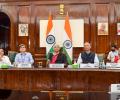
Seven of the meetings will be held in late November or early December at the finance ministry, as is the norm.

The government's annual Economic Survey on Friday strongly defended new farm laws, saying they herald a new era of market freedom which can go a long way in improving lives of small and marginal farmers in India. These legislations were designed "primarily" for the benefit of "small and marginal farmers", which constitute around 85 per cent of the total number of farmers and are the biggest sufferer of the "regressive" APMC-regulated market regime, the survey said. The pre-budget document defended the farm laws in the backdrop of long-running farmers' agitation at various borders of the national capital seeking repeal of these legislations expressing concern that they are pro-corporate and could weaken government regulated mandis, also called Agriculture Produce Marketing Committees (APMCs).

The JSP has made an electoral alliance with main opposition Communist Party of Nepal-Unified Marxist Leninist headed by K P Sharma Oli.

In his address to the joint sitting of both Houses of Parliament at the start of the Budget Session, Kovind said the Rs 64,000 crore PM Ayushman Bharat Health Infrastructure Mission will prepare the country for a health crisis in the future.

Indian companies are planning to increase investments in the new year to expand capacity, acquire companies, and go on a hiring spree, a survey of top executives showed. They, however, cited rising costs, weak consumer demand, and increasing interest rates as major concerns for 2023 which may impact their plans.

The government has been waiting for the expansion by the private sector, Finance Minister Nirmala Sitharaman said while reminding India Inc of various measures including corporate tax rate cut, policy consistency, ease of doing business, among others to facilitate investment.
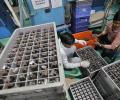
The automobile sector is considered a good indicator of economic health. It has a very long value chain, from primary materials, like metals, glass and plastic, to value-added high-end electronic components, specialised alloys, and software.

A lesson we have not learnt from China is the urgent need to knit the vast country together to keep it from falling apart at the seams. While there is considerable dent in poverty, sadly, the North East remains as distant today as it always was, points out Shreekant Sambrani.

The new agri-infra fund, the duration of which will be 10 years till 2029, aims to provide medium-to-long term debt financing facility for investment in viable projects for post-harvest management infrastructure and community farming assets through interest subvention and financial support.
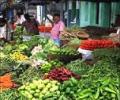
Industry bodies called for implementation of measures announced in the Budget to arrest inflation, saying these would pave the way for a stable inflation regime.

Prime Minister Narendra Modi and chief ministers of states may soon have an in-person interaction on a common platform for the first time since 2019. The seventh meeting of the Governing Council of NITI Aayog is likely to be held in late June or early July, Business Standard has learnt from sources in the Centre and a state. While the date and other details are yet to be finalised, it is learnt that there will be a conclave of chief secretaries of states and Union Territories in Dharamshala, Himachal Pradesh, on June 14 and 15, which will decide the agenda of the Council meeting to be held at a later date.

The properties include Goawala compound and a commercial unit in Mumbai's suburban Kurla (West) 147.79-acre agricultural land located in Osmanabad district of Maharashtra and three flats in Kurla (West).
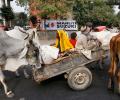
Maruti Suzuki says it has sold at least one car in 418,000 villages.

In yet another move to close the regulatory gap between banks and shadow banks, the Reserve Bank of India (RBI) has mandated exposure limits to the non-banking finance companies, in line with commercial banks. In the large exposure framework released on Tuesday, the regulator capped aggregrate exposure of NBFCs which are in the upper layer toward one entity at 20 per cent of capital base. The limit can only be extended by another 5% with board's approval. For a particular borrower group, the cap is at 25 per cent, with additional 10 per cent if exposure is towards infrastructure.
